
A single trip draws on three kinds of intelligence: the logistics of your itinerary, the practicalities of the destination and the security picture on the ground. This information ordinarily lives across separate sources. The Advance Brief brings it together with the judgment to determine what matters, so your attention can remain on the purpose of the trip.
Built from international close-protection experience →Organized and cross-referenced into a single brief you can read from start to finish, or reach into for one number at 2 a.m. on the other side of the world.
Flights, hotels, reservations, ground transport and itinerary specifics, organized, timed and cross-referenced in one place.
Currency, power, language, tipping, local transport and practical operating notes that help the day run smoothly on unfamiliar ground.
A calibrated risk assessment, entry requirements, suitable medical facilities, financial contingencies and verified emergency contacts, brought together for the moments when plans change or something goes wrong.
Each commission is delivered as a coordinated travel-readiness package, designed for use before departure and while the traveller is in motion.
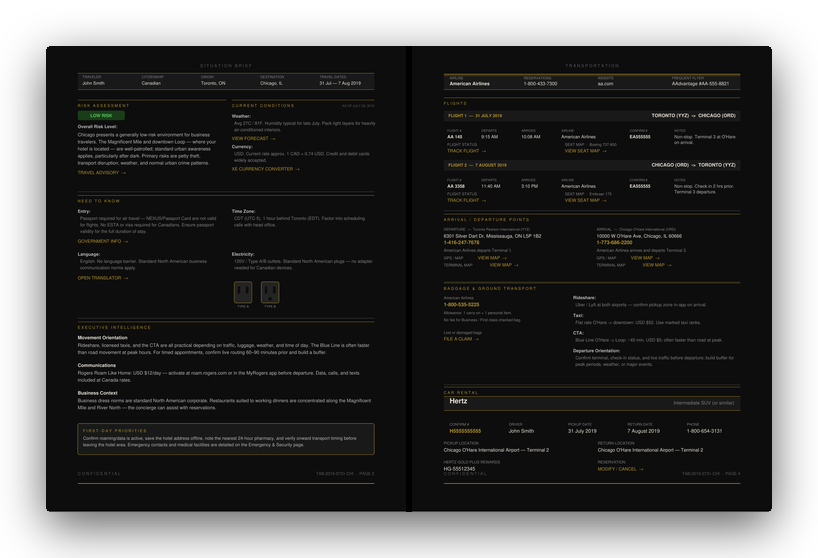
The complete itinerary, destination intelligence, risk assessment and critical reference information in one structured document.
Key timings, reservations and travel reminders placed into a usable calendar format for the traveller and those coordinating the journey.
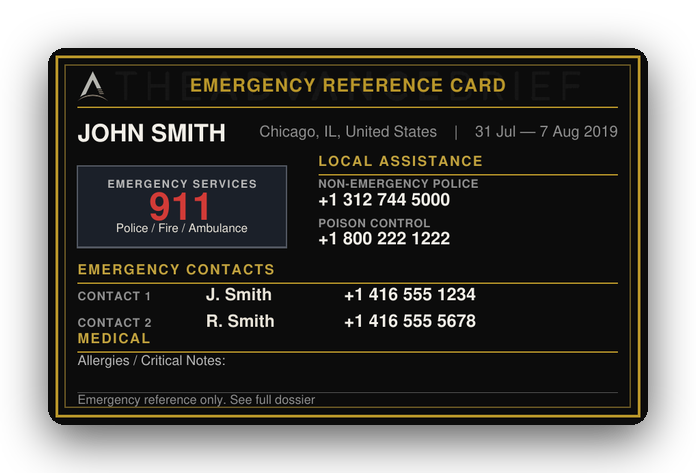
Essential contacts and critical information in a compact physical format designed to remain accessible when a phone, network or document is not.
Illustrative sample. All traveller and itinerary information shown is fictional.
Government travel advisories are written for a general population. Your trip is not a general trip. We begin with the relevant official baseline: Global Affairs Canada, the U.S. Department of State or the appropriate national authority. We then calibrate it to the itinerary, its structure and the traveller's likely exposure to identified risks. Not a lookup table. A documented judgment, calibrated to the trip and shown to you in writing.
Government advisories are checked during preparation and cited by source and date in every brief. Conditions can change after delivery, so current official advisories should also be reviewed before departure.
An answer can sound confident and still be wrong. What you are paying for is documented judgment: someone reviewed the sources, considered the trip and made the call. Not a lookup. Not a default.
The Advance Brief was developed from pre-departure intelligence methods used in international close protection. Those operational practices have been refined into a discreet briefing service for private travellers, executives and the professionals responsible for their movement.
Designed for private travellers, executives, family offices and the professionals coordinating complex international movement on their behalf.
Including executive assistants, chiefs of staff, travel advisers and protection professionals. A brief can be commissioned by the traveller directly, or by someone managing travel on another's behalf.
Share the destination, approximate dates and basic structure of the trip.
Complete the confidential traveller and itinerary intake through the private intake process provided by TAB.
TAB organizes the itinerary, researches the destination, assesses risk and reviews critical information against defined sources.
Receive the completed dossier, integrated trip calendar and physical emergency card before departure.
Contact The Advance Brief to discuss your itinerary and commission a brief. Standard delivery is within five business days. A 48-hour expedited service is available for urgent departures.
Commission a briefSubmission begins an initial private inquiry and does not commit you to purchase.
Please do not submit passport numbers, medical records or other highly sensitive personal information through this initial inquiry. Secure intake instructions will follow.
Each commission is quoted according to the number of destinations, itinerary complexity, traveller requirements and delivery timeframe.