
The Advance Brief brings the discipline of professional travel preparation to individual trips, delivered as one considered document.
The Advance Brief was developed from the pre-departure intelligence methods used in international close protection, where knowing a destination before arriving is a working requirement rather than a convenience. Those operational practices have been refined into a discreet briefing service for private travellers, executives and the professionals responsible for their movement.
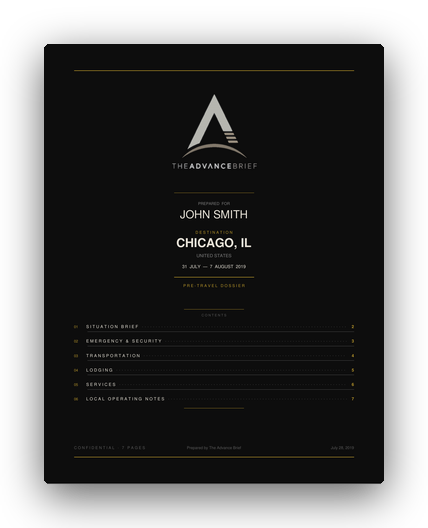
Illustrative sample. Fictional data.
A single trip draws on three separate kinds of information: the logistics of the itinerary, the practicalities of the destination, and the security picture on the ground. Assembling all of it takes hours, and the judgment to know what actually matters. Most travellers either do this in fragments or not at all. The Advance Brief consolidates it into one document, prepared before departure, so attention can stay on the purpose of the trip.
Each brief follows a defined process. Information is gathered from the traveller and from public and official sources, organised into the structure of the dossier, and assessed for risk against the relevant government baseline. Every section and every link is then reviewed, cross-checked and finalised before delivery. Government advisories are cited by source and date, so the reasoning behind the assessment is visible in writing rather than asserted.
An answer can sound confident and still be wrong. The value of a brief is not that information exists somewhere, but that a person has reviewed the sources, considered the specific trip and made the call. That judgment, applied consistently and shown in writing, is what separates a considered brief from a generic report.
Travel details are personal. We collect only what a brief requires, handle it with care, and hold it in confidence. How we manage personal information is set out in our Privacy Policy.